Singapore Power Bank Buying Guide: How to Check Wh, mAh & Airline-Safe Limits
A practical buying guide for travellers who want a power bank that is easy to understand at airport security, with Wh calculations, mAh examples and the current Singapore flight limits.
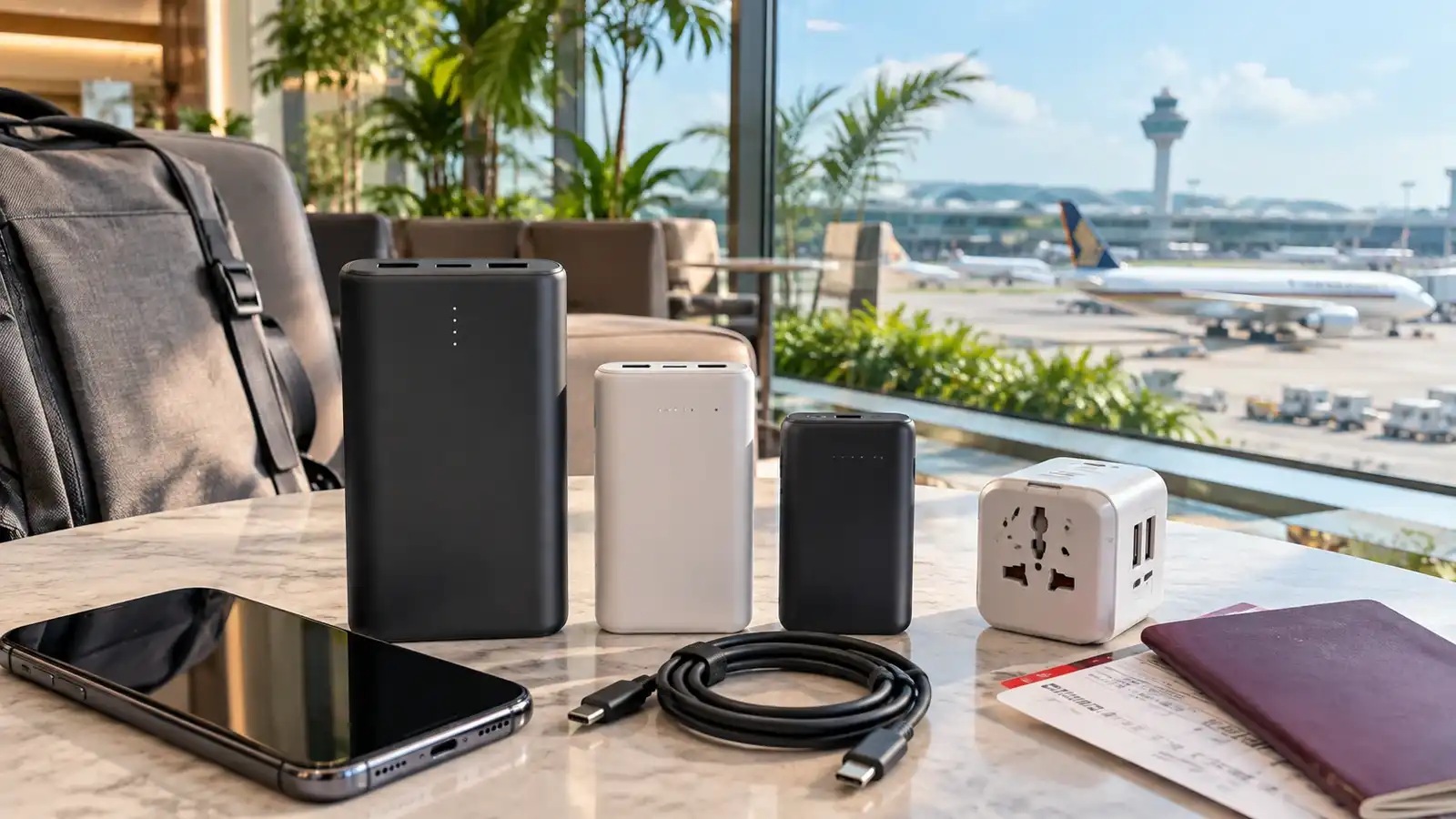
A practical buying guide for travellers who want a power bank that is easy to understand at airport security, with Wh calculations, mAh examples and the current Singapore flight limits.
- Key number
- 100Wh or less is the simplest airline category
- Approx. 100Wh
- About 27,000mAh at typical power-bank cell voltage
- 100–160Wh
- Airline approval required
- Over 160Wh
- Not allowed for passengers
- Singapore quantity limit
- Maximum 2 power banks per passenger
- Best buying habit
- Choose a unit with a clear Wh rating printed on the body
A practical buying guide for travellers who want a power bank that is easy to understand at airport security, with Wh calculations, mAh examples and the current Singapore flight limits.
Key Takeaways
- Do not shop by mAh alone: airline rules are based on watt-hours, so a clearly printed Wh rating is more useful at the airport.
- A 10,000mAh or 20,000mAh power bank is usually comfortably below 100Wh when rated at common lithium-cell voltage, while very large 30,000mAh models may cross the 100Wh threshold.
- Capacity is only one buying factor; also compare USB-C output, weight, charging speed and whether the specifications are permanently legible on the device.
Start with Wh, not just mAh
Most retail listings lead with mAh, but aviation rules use watt-hours (Wh). CAAS says the watt-hour value of a battery can be calculated by multiplying its voltage by its ampere-hour capacity.
Because 1,000mAh equals 1Ah, the working formula is:
Wh = voltage × (mAh ÷ 1,000)
Common mAh sizes converted to Wh
| Advertised capacity | Example at 3.7V | Travel implication |
|---|---|---|
| 5,000mAh | 18.5Wh | Well below 100Wh |
| 10,000mAh | 37Wh | Well below 100Wh |
| 20,000mAh | 74Wh | Below 100Wh |
| 27,000mAh | 99.9Wh | Near the 100Wh threshold |
| 30,000mAh | 111Wh | May fall into airline-approval territory if the rated voltage produces this Wh value |
These are illustrative calculations only. Use the manufacturer's printed Wh rating where available because the actual rated voltage and usable capacity can differ from a simple example.
Current Singapore flight limits to buy around
For flights departing Singapore, CAAS currently allows a maximum of two power banks per passenger. Power banks up to 100Wh are allowed in cabin baggage under that quantity limit. More than 100Wh and up to 160Wh requires airline approval, while anything above 160Wh is prohibited for passenger carriage.
Power banks are not allowed in checked baggage and must be individually protected from short circuits.
What capacity should most travellers buy?
For most phones, a 10,000mAh unit offers a useful balance between weight and emergency charging. A 20,000mAh model is more useful for long sightseeing days, multiple devices or heavy phone use, but it is noticeably heavier.
The closer you get to the 100Wh ceiling, the more important it becomes to check the actual label rather than assuming the advertised mAh is automatically flight-friendly.
Why the physical label matters
Choose a power bank with its electrical ratings permanently printed or clearly marked on the device. Airport staff need to determine the battery capacity, and an unreadable or missing label creates unnecessary uncertainty even when an old online listing claims the model is compliant.
A useful label should make it easy to identify the model, rated capacity and Wh figure.
USB-C output and charging speed
After capacity, look at how you actually charge your devices. USB-C Power Delivery can be valuable for newer phones, tablets and some laptops, while multiple ports help if you carry more than one device.
Do not pay for an oversized battery simply to get faster charging. Capacity and output power are separate specifications.
Weight matters more than people expect
A very large power bank may look attractive on paper but can become an annoyance in a small day bag. For city travel, the best unit is often the smallest capacity that reliably covers your day rather than the largest model you can legally board with.
Power bank buying checklist
- Look for a clearly printed Wh rating.
- Keep comfortably below 100Wh if you want the simplest air-travel category.
- Compare mAh only after checking the rated voltage/Wh.
- Choose USB-C output that matches the devices you actually carry.
- Consider weight and thickness for daily use.
- Avoid damaged, swollen or poorly labelled batteries.
Buying guide vs flight rules
This page is about choosing the right unit. For the full carriage rules, cabin-only requirement and onboard-use restrictions, read our Singapore Power Bank Flight Rules 2026. Also see our Singapore plug and power-adapter guide and Tourist SIM vs eSIM guide for the rest of your travel-tech setup.
Sources
Primary sources used for this guide: