Singapore Plug Type & Power Adapter Guide for Visitors
Singapore uses Type G three-pin plugs and 220–240V AC power. Here is what visitors should know about adapters and local safety marks.
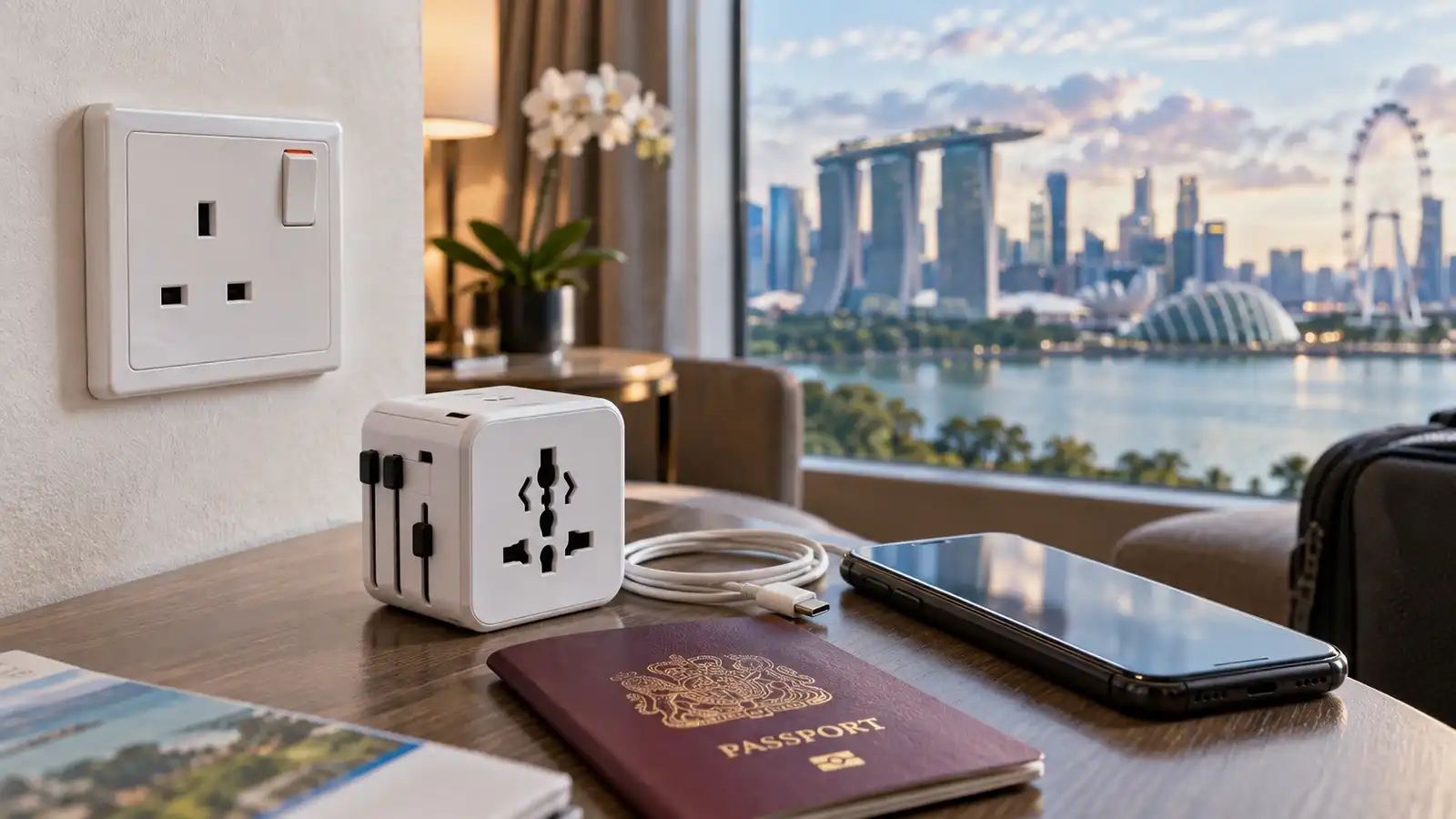
Editorial illustration: The Singapore Best
- Plug type
- Type G — three rectangular pins
- Mains supply
- 230V single-phase, 50Hz
- Travel adapter
- Needed if your plug does not fit a Type G socket
- Voltage converter
- Only needed if your device does not support Singapore’s voltage range
- Local safety
- Controlled adaptors and plugs sold locally should meet Singapore safety requirements
Singapore uses the Type G three-pin plug, the same basic plug format used in the United Kingdom. The standard supply is 220–240V AC, 50Hz, so most modern phone and laptop chargers work without a voltage converter if their input label supports that range.
Key Takeaways
- Singapore uses the Type G three-pin plug, the same basic plug format used in the United Kingdom.
- The standard mains plug has three rectangular pins.
- If your charger uses another plug shape, you need a travel adapter that fits a Type G socket.
What plug type does Singapore use?
The standard mains plug has three rectangular pins. Visitors from the UK, Malaysia, Hong Kong and some other markets may already use compatible plugs.
Do you need a travel adapter?
If your charger uses another plug shape, you need a travel adapter that fits a Type G socket. An adapter changes the physical plug connection; it does not automatically change voltage.
Do you need a voltage converter?
Check the input label on your charger or appliance. Devices marked for a broad input such as 100–240V are generally designed for international voltage ranges. Appliances rated only for a lower voltage may require an appropriate converter.
What should you buy locally?
Singapore’s Consumer Product Safety Office says controlled household electrical products must carry a valid SAFETY Mark before they can be legally supplied. This includes categories such as AC adaptors and certain plugs.
Are universal wall sockets recommended?
The Consumer Product Safety Office warns that universal socket-outlets can carry electric-shock and fire risks and says they should not be installed in homes for daily use.
Quick check before plugging in
Confirm the plug fits correctly, the device supports Singapore’s voltage, and any locally purchased controlled adaptor carries a valid SAFETY Mark.
Type C and Schuko plugs: an important difference
Singapore's Consumer Product Safety Office recognises a 2.5A two-round-pin Type C plug for certain low-power, double-insulated appliances, but it should be connected to a local three-pin socket with a suitable adaptor rather than forced into the outlet. A larger Schuko-style plug is different: the safety office specifically warns that Schuko plugs are not suitable for Singapore sockets because their pin dimensions and side-earthing arrangement can create poor contact, overheating and ineffective earthing.
This distinction matters for visitors from continental Europe. A small phone charger with a slim two-pin Europlug may only need a properly designed travel adaptor, while an appliance fitted with a larger Schuko plug should not simply be pushed into a universal or improvised socket.
Adapter vs voltage converter: quick examples
A travel adapter only changes the plug shape. A voltage converter changes the electrical supply delivered to the appliance. Before packing a converter, read the small input label on the charger or power brick. If it says something such as 100–240V, 50/60Hz, it is designed for a broad international voltage range and normally only needs the correct plug connection in Singapore.
Higher-powered personal appliances deserve more care. Hair dryers, styling tools and older appliances may have a narrower voltage rating. If the label does not include Singapore's 230V supply, do not assume that a plug adapter makes the appliance safe to use.
Visitor power checklist
- Check every device's input-voltage label before travel.
- Bring a Type G travel adapter if your plug is not compatible.
- Do not force two-pin or Schuko plugs into a Singapore wall socket.
- For locally purchased controlled plugs or adaptors, look for a valid SAFETY Mark.
- Avoid relying on loose-fitting universal sockets or unlabelled travel adaptors.
Visitors can continue their pre-trip checklist with our Singapore passport-validity guide and GST refund guide for tourists .
Sources
Primary sources used for this guide: